Blog
Insights from the Invert team.
Perspectives on bioprocess data, AI in biomanufacturing, and building the intelligence layer for biopharma teams.
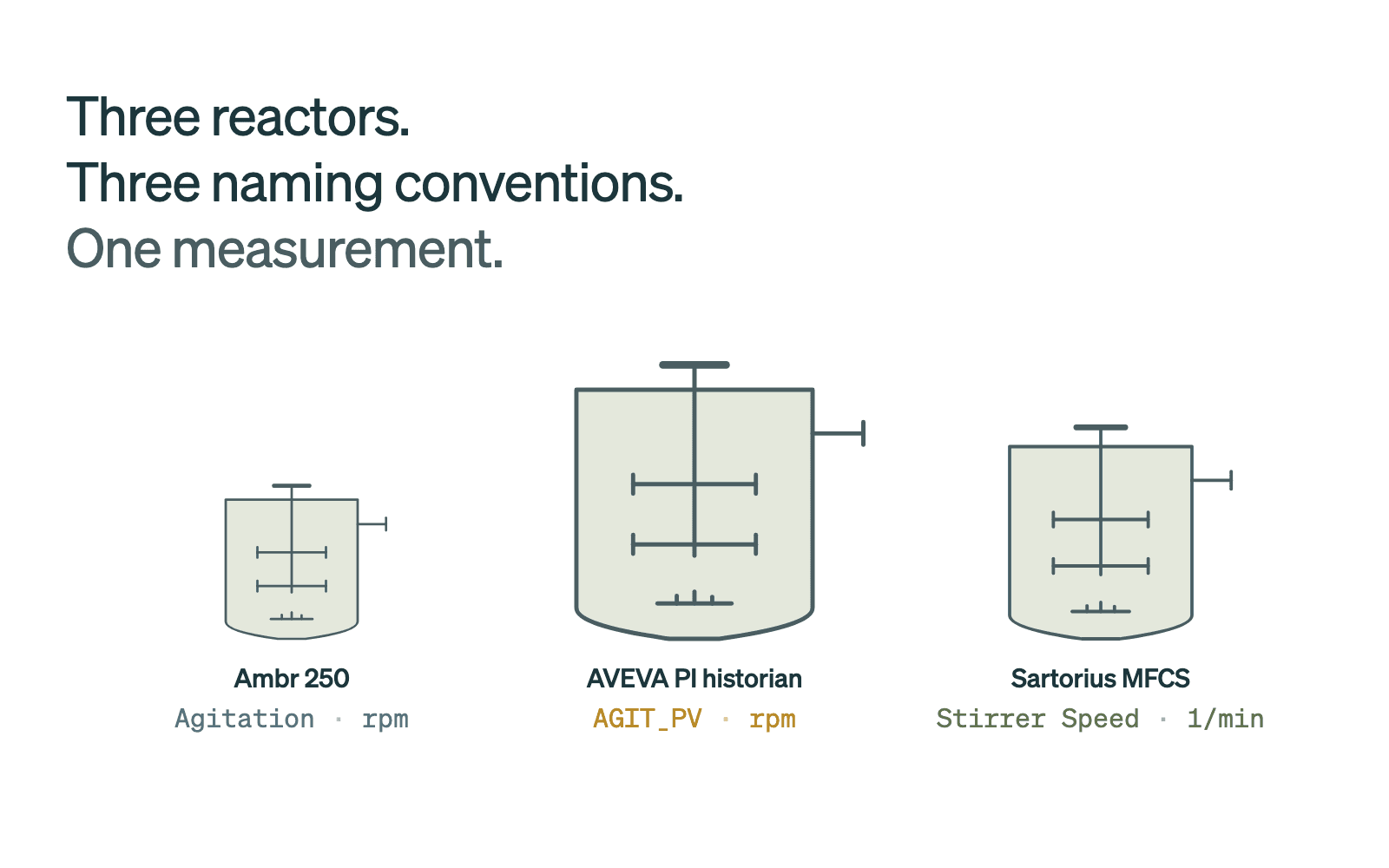
Harmonizing bioprocess metrics across instruments and runs
Harmonizing bioprocess metrics across instruments and runs usually stalls behind a naming committee. Given a simulated library of 2,486 metric definitions, Invert Assist triaged 209 candidate matches against the parent metrics already in place, reconciled their unit strings against the unit registry, and staged 53 parent-child mappings across 6 parent metrics for review, with nothing applied to the database. The argument: standardization should not be a gate to doing science, and "we'll fix it later" works when changes are staged, reviewed, and logged.
Read article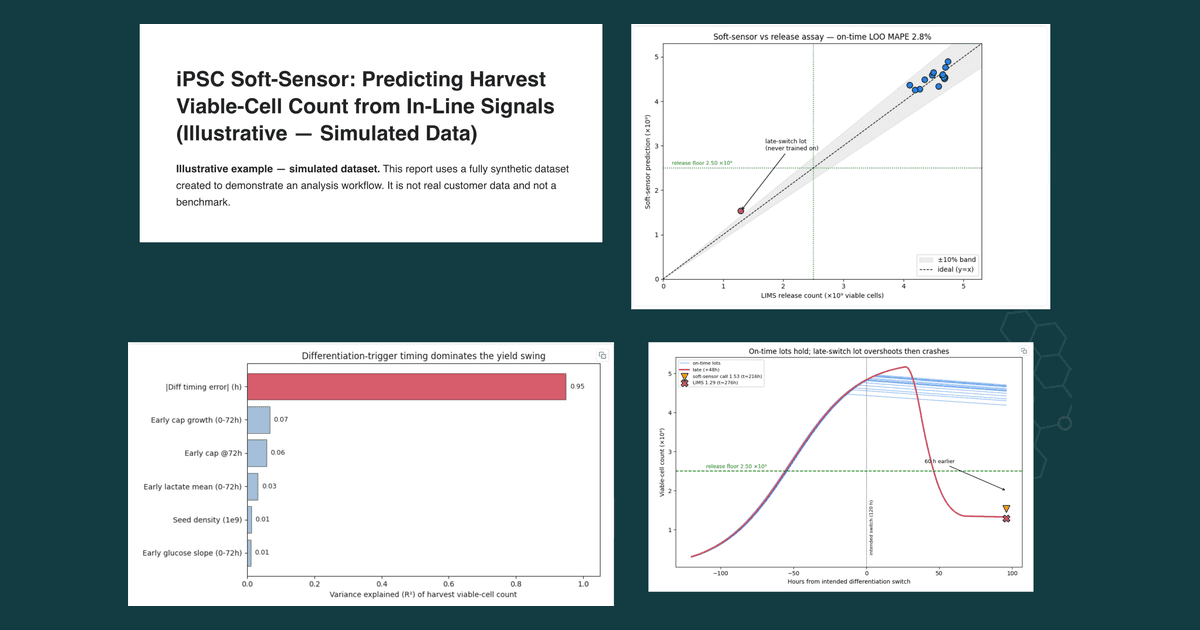
Using in-line signals to predict viable-cell yield across iPSC-derived production lots
Across 16 simulated iPSC-derived production lots (same donor material, medium, and feed), viable-cell yield still swung from about 1.35 to 4.68 ×10⁹ cells per lot. Invert Assist read all 16 lots as one dataset, built an in-line soft sensor that predicts harvest viable-cell count to within about 5–10% from reactor signals alone, and traced the swing to a single controllable variable: differentiation-trigger timing. A lot switched 48 hours late overshot in expansion, then crashed, and the soft sensor flagged it about 60 hours before the release assay could. (Simulated demonstration data.)
Read article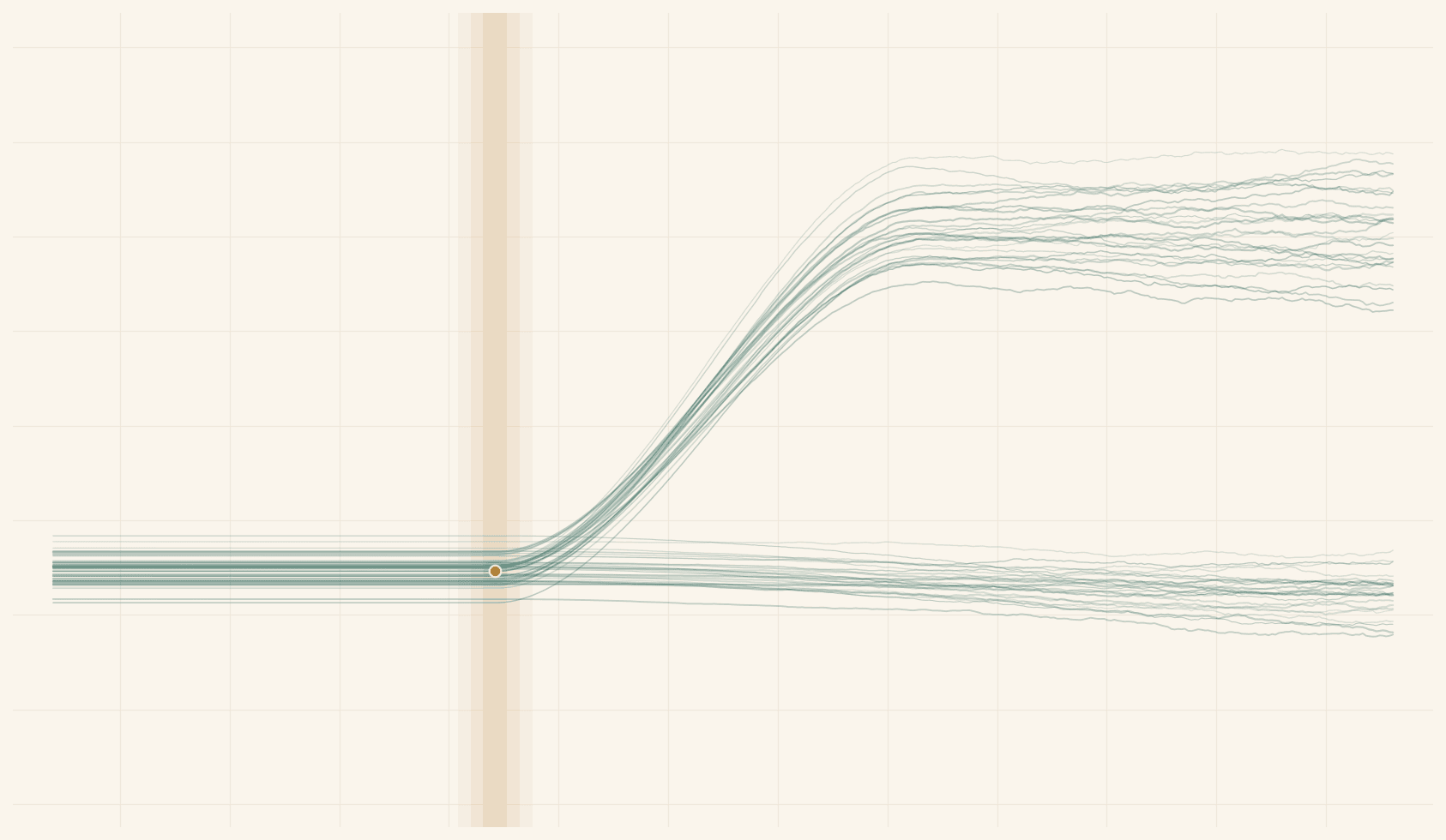
The Metabolic Switch Behind CHO Titer Variability
Across 40 fed-batch runs on the same CHO platform, Assist, Invert's analysis tool for bioprocess data, traced the titer split to a single metabolic signal: which runs cleared their lactate by mid-culture, and which never did.
Read article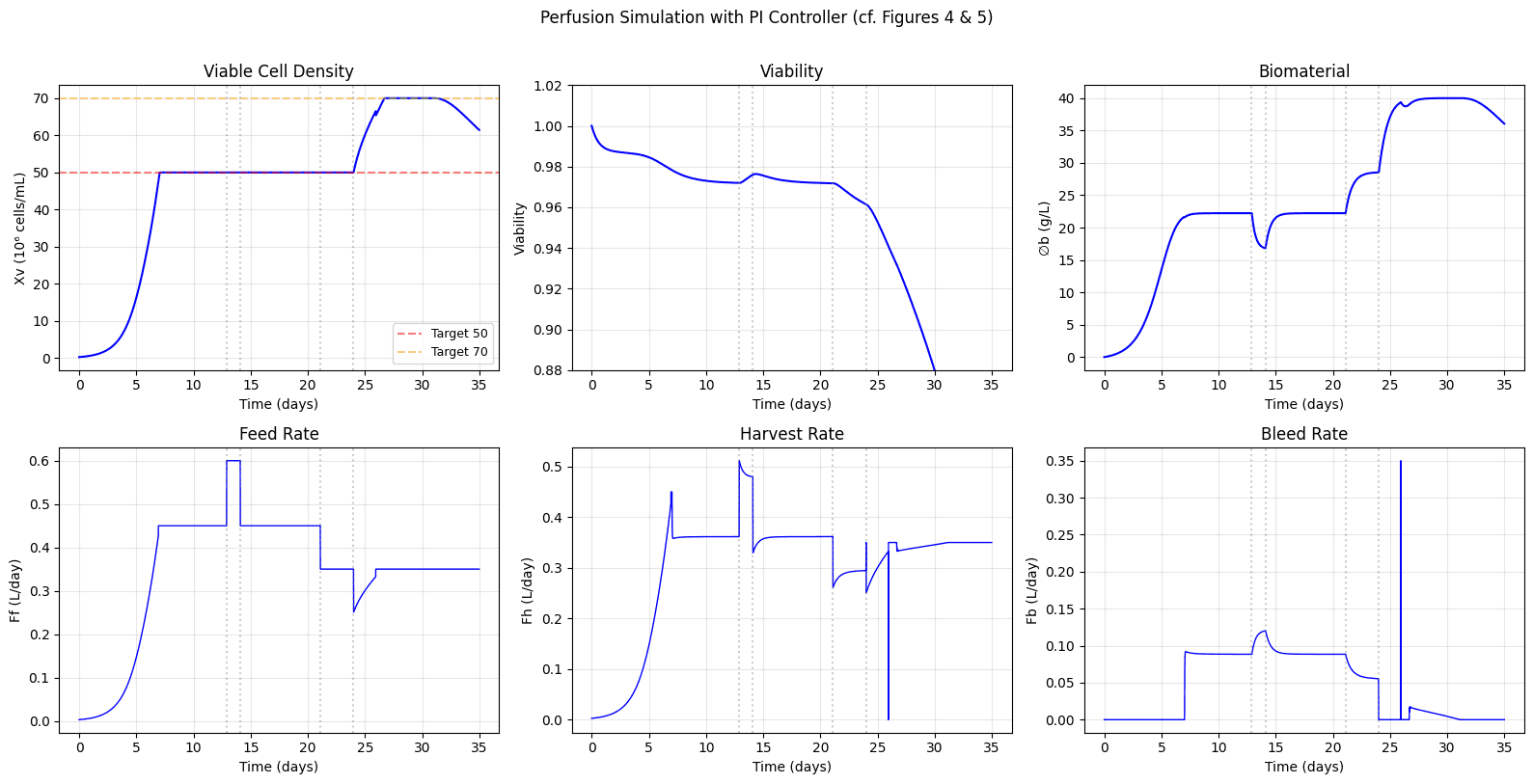
Reproducing a Published CHO Perfusion Model in Invert Assist
We rebuilt Richelle et al.'s 2022 CHO cell-culture intensification model in Invert Assist, turning a published paper into an executable, interactive report. The central question: could parameters fit on small-scale fed-batch data reproduce the paper's perfusion design without re-estimating the model? They could — and the reproduction surfaced a units mismatch, showed the bleed controller absorbs most parameter uncertainty, and pinpointed direct lysed-cell measurement as the highest-value next experiment.
Read article
Bioraptor vs. Invert vs. Genedata: Best Bioprocess AI Platform for Scale-Up & Pharma Manufacturing
Compare Bioraptor, Invert, and Genedata to see which bioprocess AI platform delivers the fastest scale-up, real-time insights, and AI-ready data for pharma and bioprocessing teams. Understand why experts choose Invert for USP, DSP, and manufacturing.
Read article
How to Integrate Bioprocess Data Across Sites, Systems, and CDMOs | Invert Bioprocess AI
Learn how to integrate bioprocess data across instruments, LIMS, sites, and CDMOs without manual work or IT burden. See how modern bioprocess teams accelerate scale-up with automation, harmonization, and built-in intelligence.
Read article.png&w=3840&q=75)
Engineer Blog Series: From Bioprocess to Software with Anthony Quach
Welcome to Invert’s Engineer Blog Series — a behind-the-scenes look at the product and how it’s built.In this post, software engineer Anthony Quach shares how his career in bioprocess development led him into software, and how that experience shapes the engineering decisions behind Invert.
Read article
Connecting Shake Flask to Final Product with Lineage Views in Invert
Invert’s lineage view connects products across every unit operation and material transfer throughout the entire process. It acts as a family tree for your product, tracing its origins back through purification, fermentation, and inoculation. Instead of manually tracking down the source of each data point, lineages automatically show material streams as they pass through each step.
Read article
Engineer Blog Series: Invert Assist with Simon Sotak Gregor
Invert recently launched Invert Assist, our AI interface for bioprocess data analysis. We speak to senior software engineer Simon Sotak Gregor about Invert Assist to learn more about how it was built, what problems it solves, and how he hopes it’ll change the way bioprocess is done.
Read article
Engineer Blog Series: Integrations with Julia Miller
Senior software engineer Julia Miller speaks to us about Invert's integrations — how they're implemented, what makes them special, and what goes into making them work for bioprocess.
Read article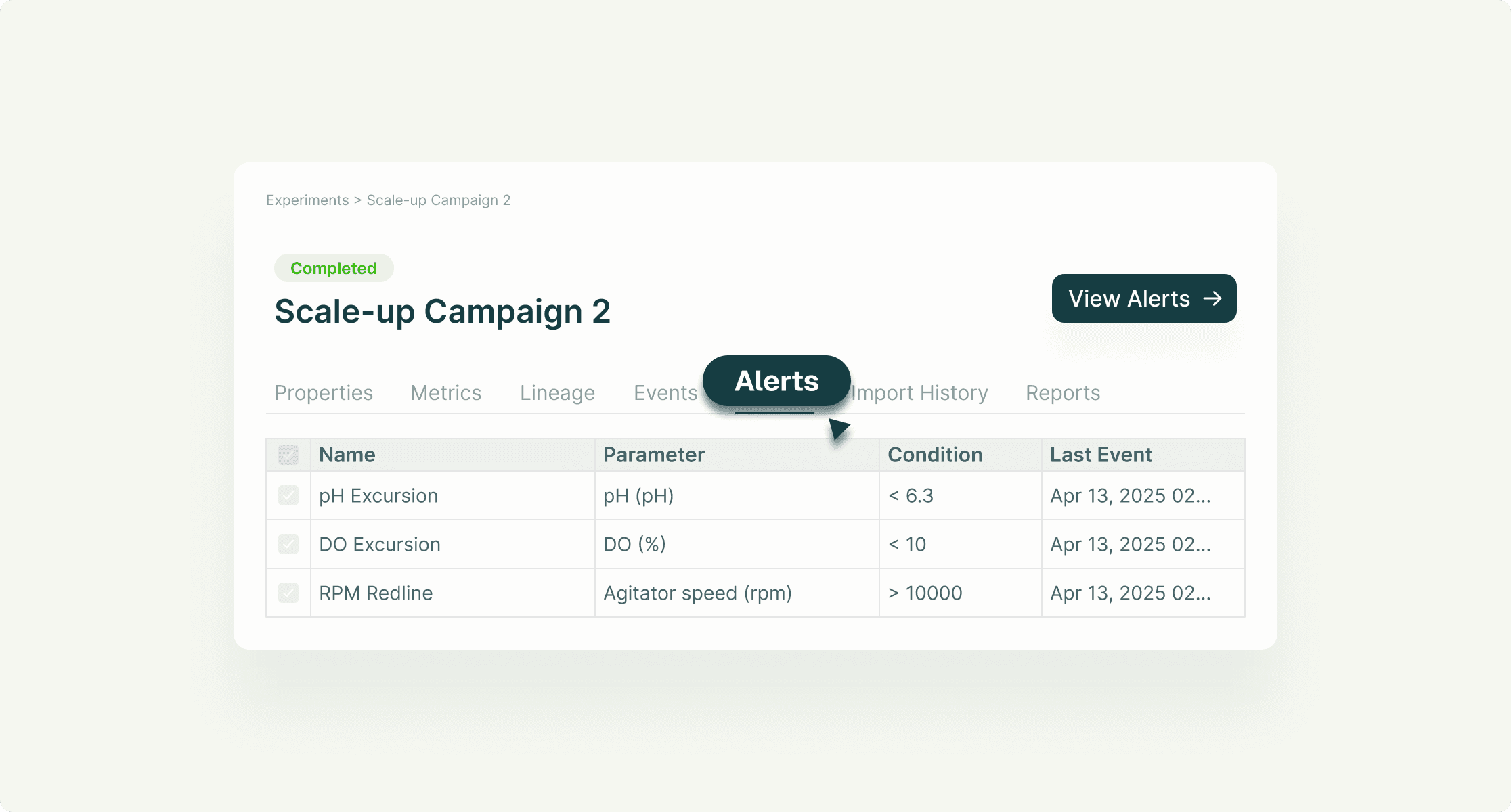
Invert Launches Alerts: Turning Real Time Data Into Immediate Action
Invert Alerts transform real time bioprocess data into immediate, actionable notifications so scientists can act in the moment, protect their runs, and focus on advancing processes instead of manually monitoring them
Read article
Engineer Blog Series: Security & Compliance with Tiffany Huang
Welcome to Invert's Engineering Blog Series, a behind-the-scenes look into the product and how it's built. For our third post, senior software engineer Tiffany Huang speaks about how trust and security is a foundational principle at Invert, and how we ensure that data is kept secure, private, and compliant with industry regulations.
Read article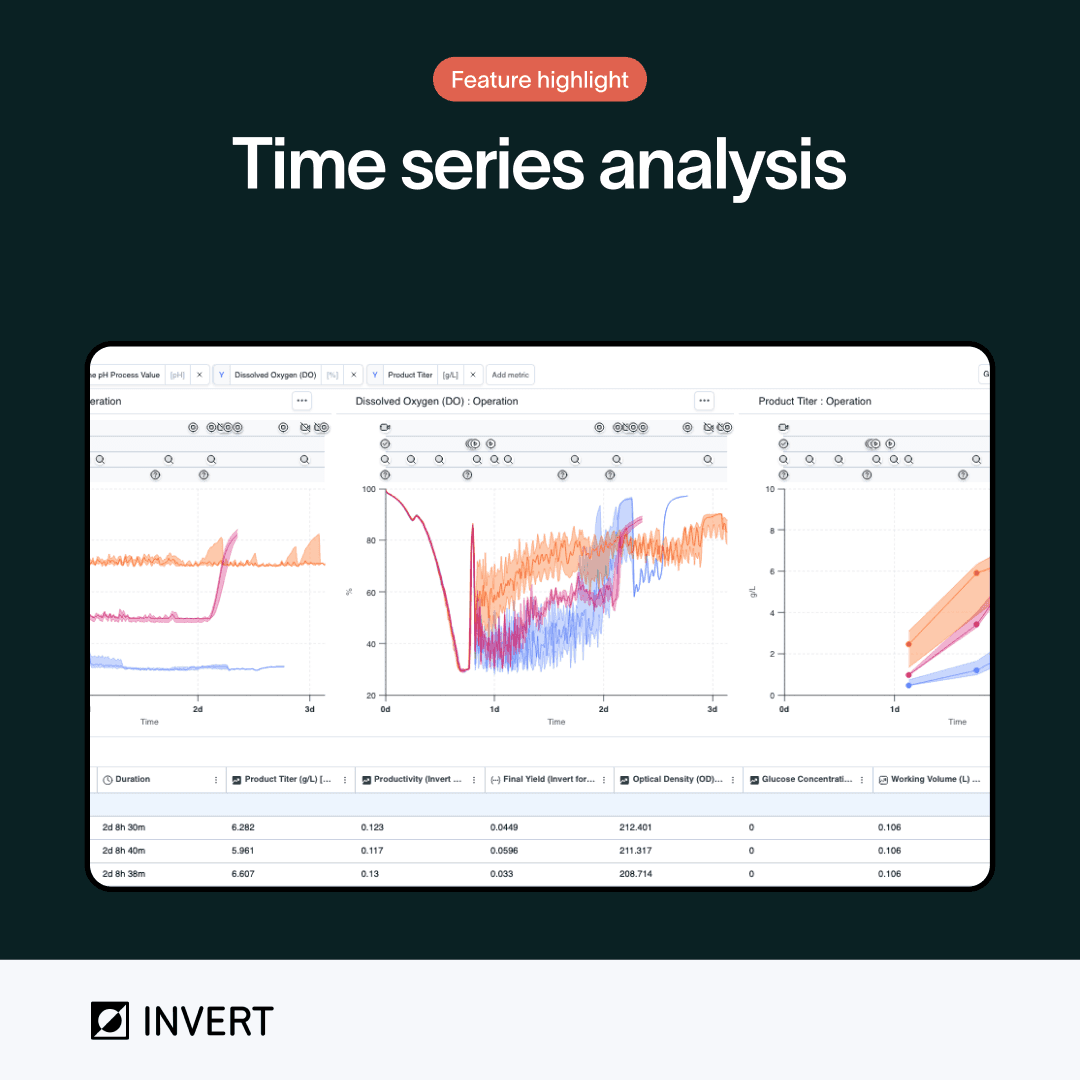
Analyzing Real-Time Time Series Data in Bioprocess with Invert
In modern biomanufacturing, success hinges on the ability to make informed decisions fast. The ability to analyze data directly impacts productivity, product quality, and ultimately, time to market, whether you're optimizing a fed-batch fermentation, troubleshooting a chromatography run, or validating a filtration process. However, its massive volume, high dimensionality, and low latency of time series data in bioprocess means that most software are not built to effectively capture, let alone analyze it.
Read article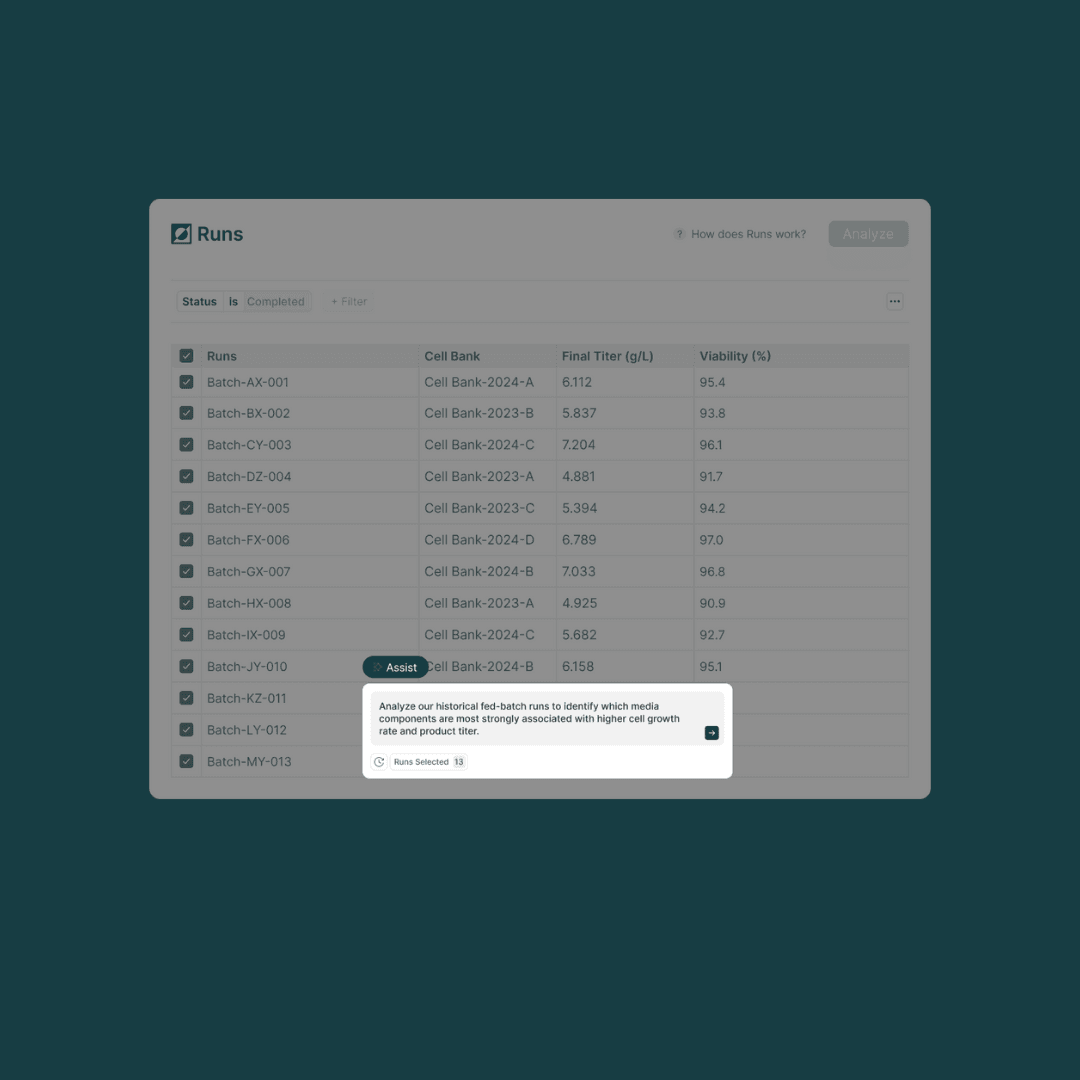
Introducing Invert Assist — Explainable AI for Bioprocess Quality Control, Monitoring, and Optimization
Biopharma teams don’t fail at AI because models are weak. They stall because data is fragmented. In our new webinar, we introduced Invert Assist—the AI layer purpose-built for bioprocessing—and showed how pairing explainable AI with a trusted, harmonized data foundation accelerates scale-up, improves bioprocess quality control, and cuts wasted runs.
Read article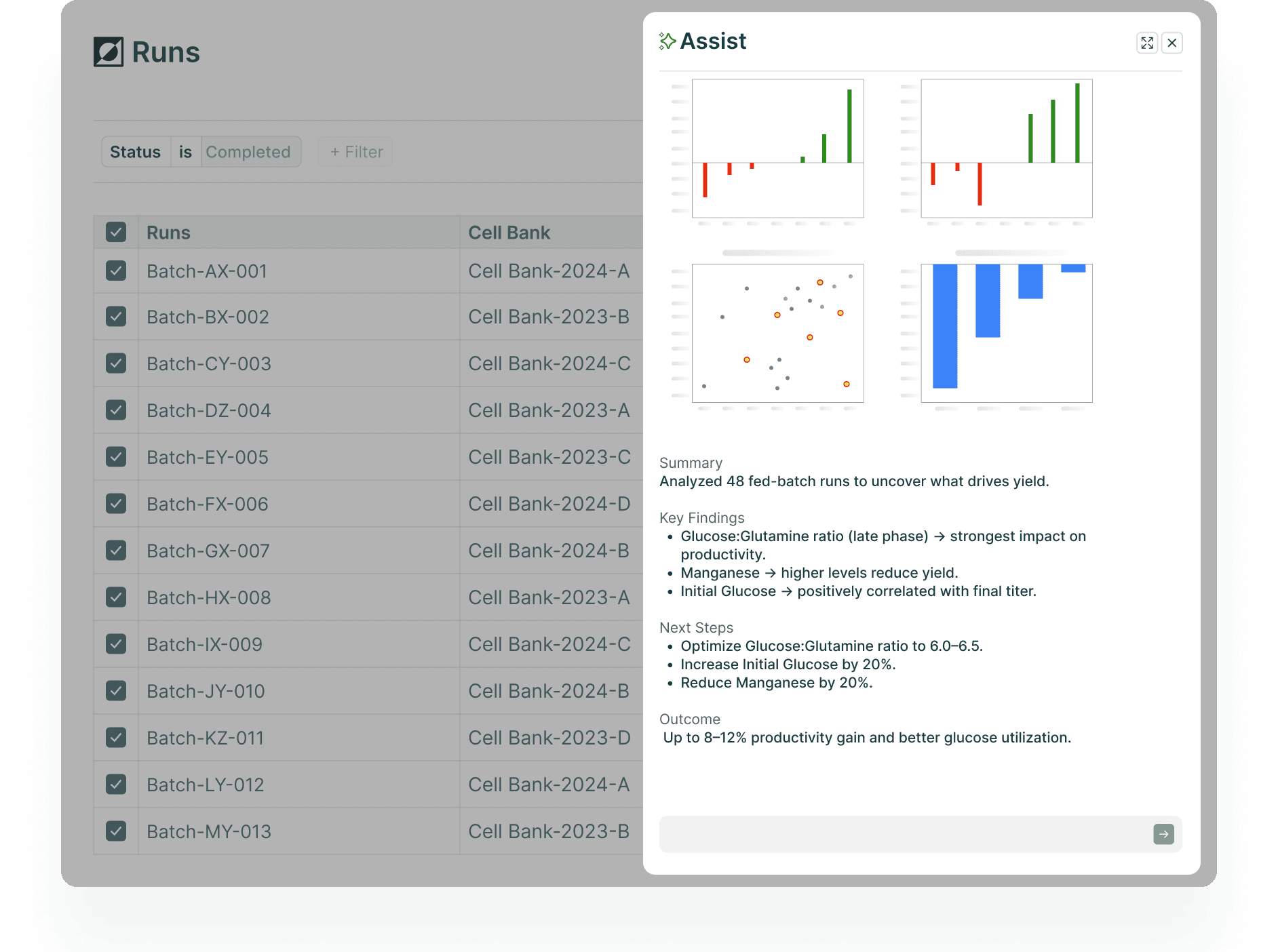
Invert Launches Invert Assist
Today, Invert launches Invert Assist, the first AI-powered analysis interface built for bioprocess. Using a simple chat interface, Invert Assist enables users to perform complex analysis that typically takes an expert team hours to code manually. With the freedom and flexibility of natural language, bioprocess scientists can turn days or even weeks of troubleshooting and optimization into a 5-minute conversation with their data.
Read article
How Invert uses batch context to make your data valuable—instantly
Bioprocess teams can spend dozens of hours every week exporting data and manually cutting it up to assign it to the batches they care about. We’ve built a way for users to easily add batch context, whether it’s just labeling data after a run, or pre-programming an integration to inject that context on the fly.We’ve built a way for users to easily add batch context, whether it’s labeling data after a run, or pre-programming an integration to inject that context on the fly.
Read article
Why ELNs and LIMS are not enough for PD teams
One of the questions we’re asked frequently is whether Invert is an ELN or LIMS—our answer is that Invert captures both systems’ strengths and fixes their weaknesses. We’ll discuss the trade-offs and shortcomings of ELN and LIMS when it comes to bioprocess data to explain how.
Read article.png&w=3840&q=75)
How Invert uses meta-learning to leverage old bioprocess data
With meta-learning techniques, Invert’s ML team was able to reduce new data needs by as much as 90% by leveraging old data from different, but loosely related, bioprocess programs.
Read article