Why isn’t an ELN or LIMS sufficient for process engineers?
Process engineers are often asked to fit their workflows into tools that were originally developed for different purposes. Two common product categories that encapsulate many of these tools are Electronic Lab Notebooks (ELNs) and Laboratory Information Management Systems (LIMS).
But what happens when you try to fit a process to a tool isn’t designed for it? One of the questions we’re asked frequently is whether Invert is an ELN or LIMS—our answer is that Invert captures both systems’ strengths and fixes their weaknesses. We’ll discuss the trade-offs and shortcomings of ELN and LIMS when it comes to bioprocess data to explain how.
ELN vs. LIMS: what are the trade-offs?
Both an ELN and a LIMS deal with data differently: an ELN makes it easy to record and store data, while a LIMS provides a structure to organize it. What are the trade-offs of each approach, and how do these trade-offs impact process engineers and scientists?

Recording data in an ELN is like storing information in a loose stack of paper: it's easy to add new information, but it's not organized. Using a LIMS is like storing it in a filing system: organized, but rigid and takes effort to design and maintain.
An ELN is flexible, but unstructured
ELNs are great at allowing scientists to input freeform data: text, numbers, images, uploaded excel sheets. There aren't any limitations on how or what kind of data goes in. They’re designed to track experimental data in a compliant manner, eventually supporting IND filings with the FDA.
There's a trade-off to this flexibility: ELNs are often not connected to an underlying database. You wouldn't be able to aggregate results against a molecule or compound, or search across experiments by metadata tags. Setting up a structured database can require extensive configuration or customization. In practice, this often means a subset of key data is more formally documented—compound IDs, cell lines, important assay results—and added to the database.
LIMS are organized, but rigid
On the other hand, Laboratory Information Management Systems (LIMS) are great at aggregating results across experiments and defining sample and data hand-offs between teams. They’re designed around sample-centric workflows to manage results and inventory in a compliant manner.
In contrast to an ELN, most LIMS have a rigid data model. This makes them great for Analytical Tech Ops, when the goal is to characterize timepoint samples pulled from bioreactors. However, they're not well suited to exploratory, one-off experiments commonly performed in process development. Their inflexible structure means that process engineers have to spend extra time reformatting their data to fit into pre-defined fields. With all that extra effort, most of them to revert to using Excel and their visualization tool of choice.
Bioprocess generates data an ELN or LIMS can’t fully capture
There are unique forms of data that bioprocess generates – and a lot of contextual information needed for bioprocess data to make sense.
An ELN can’t capture time-series data
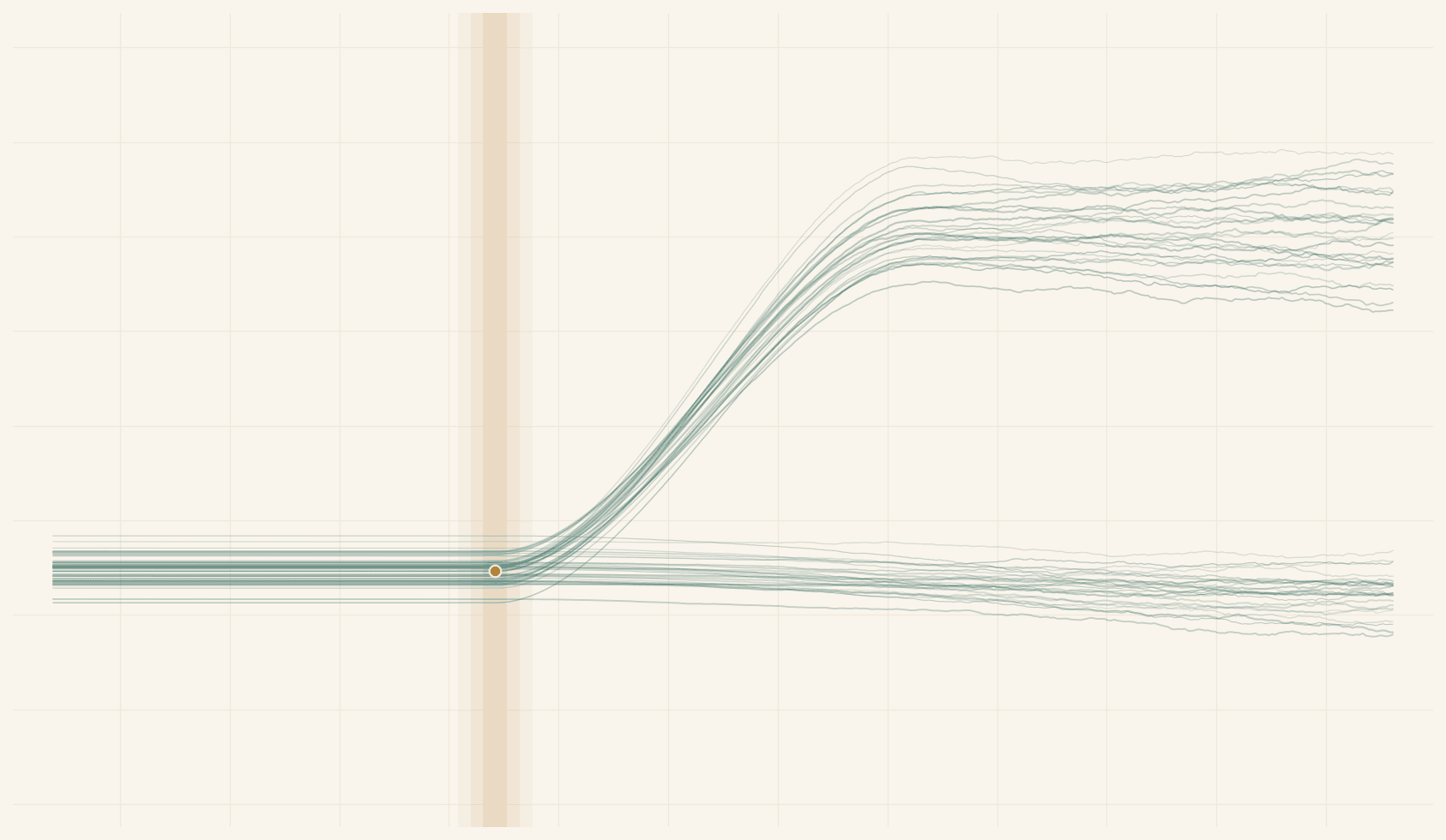
For all their flexibility, ELNs aren’t set up to capture one key form of bioprocess data: large, time-series datasets from bioreactors. They also aren’t set up to perform multi-variate analysis and generate the kinds of visualizations needed to interpret and learn from a large number of process development runs.
LIMS can’t contextualize offline data
Bioreactor data also only truly makes sense in context. LIMS can organize offline data coherently, but struggle to contextualize it within the experimental conditions of a run. For most LIMS, overlaying a view of key online process data onto offline data remains challenging. Most process engineers still find themselves using an additional visualization tool such as Spotfire or JMP to perform exploratory analysis or modeling.

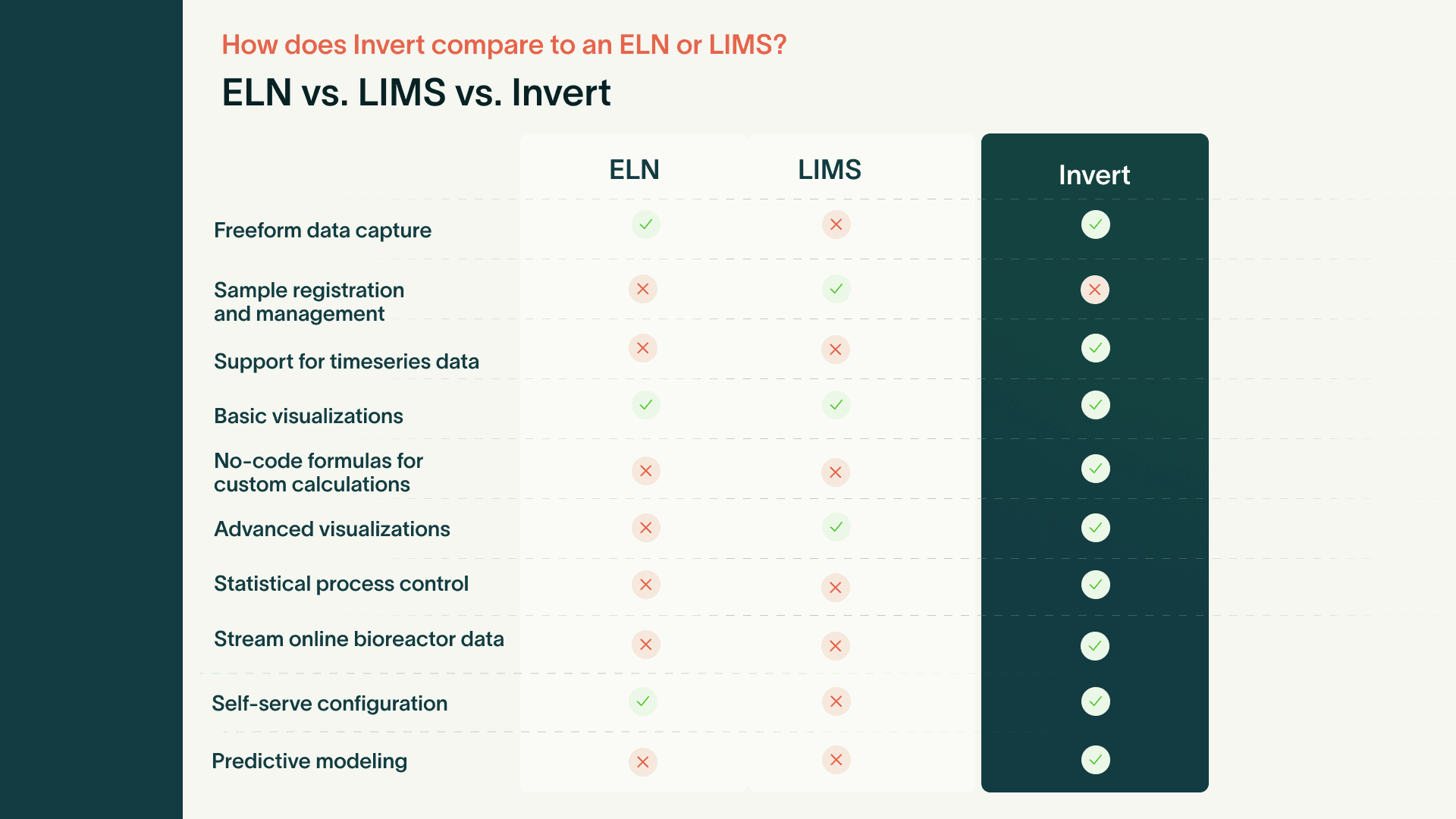
A comparison of features between an ELN, a LIMS, and Invert
Why process development scientists use Invert alongside their LIMS
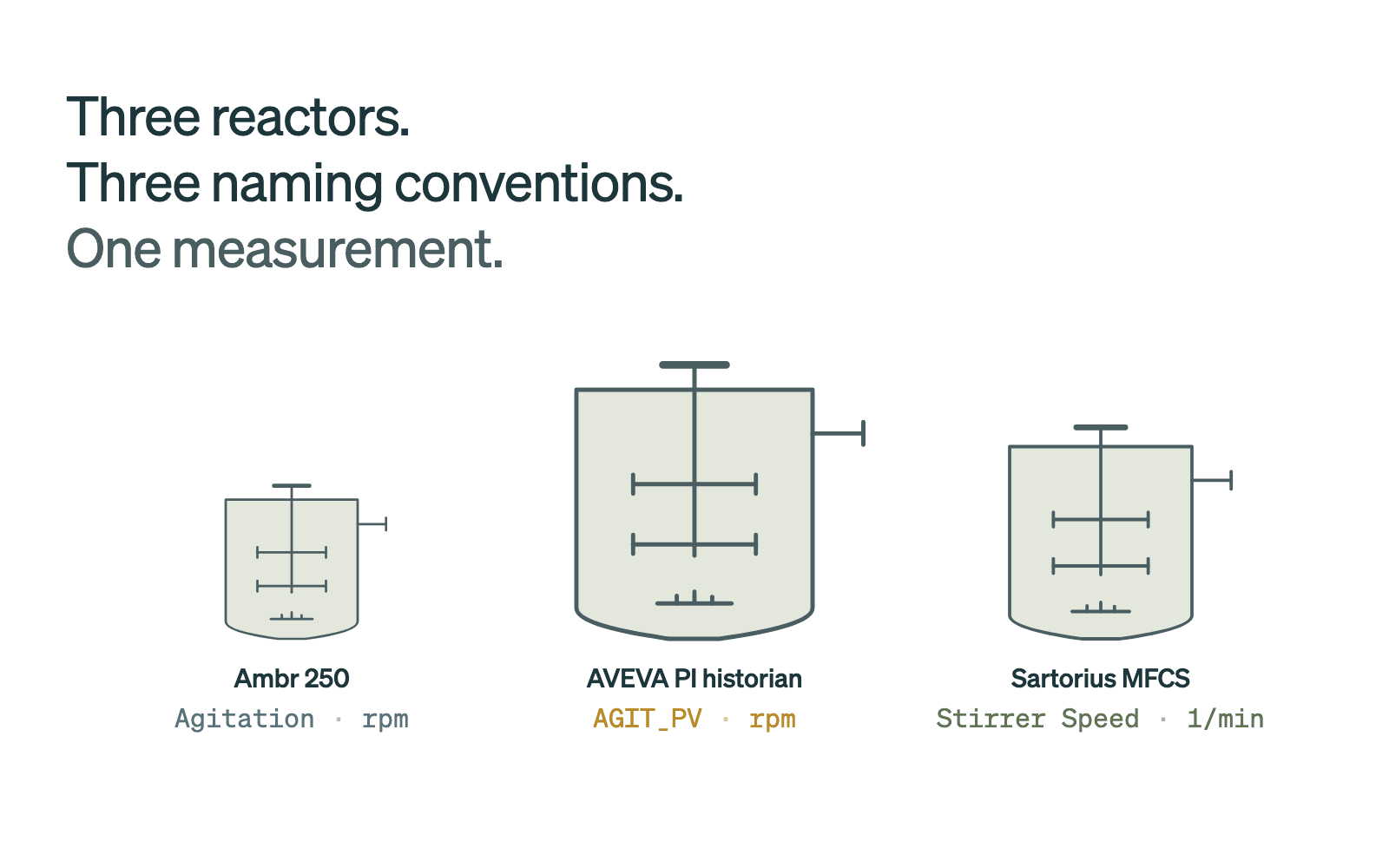
Invert is a cloud-native application designed specifically for process engineers working on process development. The system collects and standardizes data from multiple sources and transforms it into analysis-ready datasets, giving you real-time online data in the context of the full run conditions. With Invert's native understanding of time series data and built-in unit awareness, scientists can easily write complex formulas to standardize calculations across teams. Essentially, Invert handles all the messy data processing behind the scenes, so you can focus on analyzing data.
If you have an existing ELN or LIMS (or both), you don’t need to replace all your software. Invert can work with them—pre-built integrations mean that your cell line development and analytical teams can keep using the systems they’re already using. Relevant data is simply synced into Invert. With one centralized platform, your bioprocess engineers get a unified view of both online and offline data, alongside key metadata like experimental conditions.
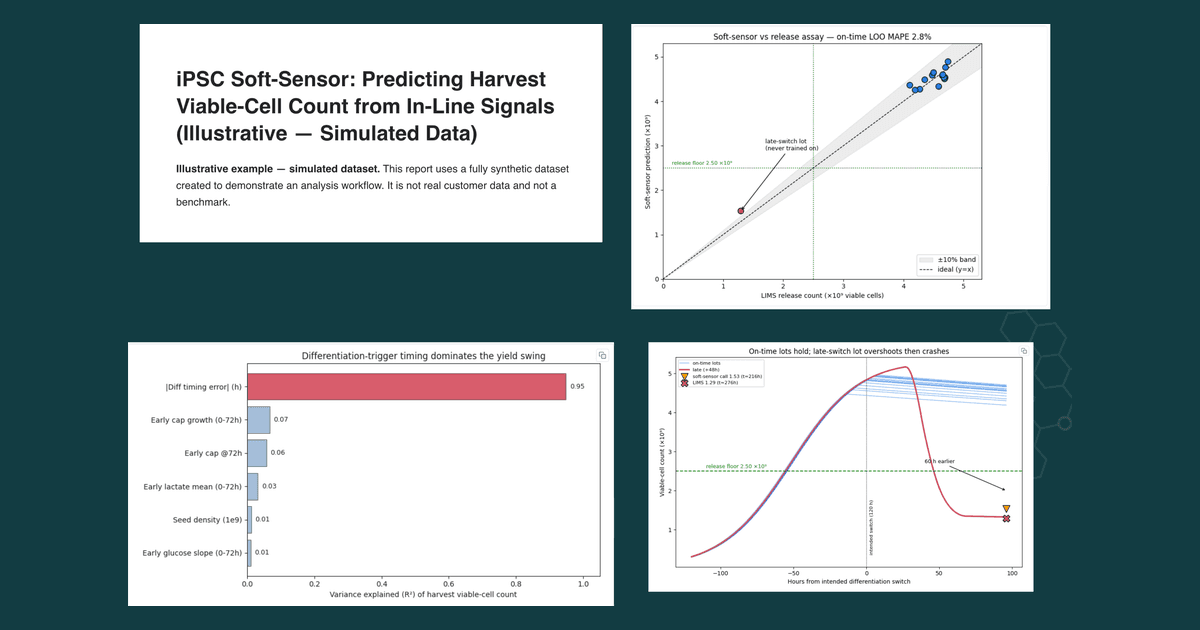
Invert also helps you deal with historical data. It cleans and adds it to the system so that past results become comparable and searchable. Train models on all your process data, using it to power predictive modeling that suggests optimal process parameters—specifically for your processes.
Invert is designed to be easy to use and quick to set up. No months-(or years-)long implementations—we help customers get live in as little as 2-4 weeks.