TL;DR
Bioprocess data integration connects the systems that hold process data, such as bioreactor controllers, historians, analytical instruments, laboratory information management systems (LIMS), and electronic lab notebooks (ELN), and links each value to the run or batch it came from. This list compares six platforms that do part or all of that work: Invert, Qubicon, Körber PAS-X Savvy, LabKey Server SDMS (scientific data management system), Genedata Bioprocess, and TetraScience. They differ most in which sources they connect and whether they organize data around bioprocess runs or around lab records.
Updated September 2026. Invert publishes this list and is one of the platforms on it. Performance figures are reported by the companies themselves.
This post compares vendors. For a step-by-step approach to planning an integration project, see Best Practices for Bioprocess Data Integration. For AI platforms that model and optimize the process itself, see 7 Best AI Bioprocess Optimization Platforms.
Bioprocess Data Integration Platform Comparison
| Platform | What it connects | Best for |
|---|---|---|
| Invert | Bioreactor controllers and historians over AVEVA PI, OPC UA, and OPC DA; Benchling ELN; LIMS and other data by file import or API | Bioreactor, historian, and lab data in one layer, linked to the run it came from |
| Qubicon | Online, at-line, and offline bioprocess equipment, over OPC UA or Qubicon's PAT-Box | Comparing live runs against reference runs |
| Körber PAS-X Savvy | Manufacturing and quality data sources | Manufacturing and quality data with statistical trending and continued process verification (CPV) support |
| LabKey Server SDMS | Lab instruments, systems, and databases | Labs that want a customizable scientific data management system |
| Genedata Bioprocess | Laboratory instruments, including bioreactors | Lab instrument data, including bioreactors |
| TetraScience | Lab data, converted to a harmonized, vendor-agnostic format | Lab data integration across many instrument vendors |
Why Bioprocess Data Integration Matters in 2026
A single cell culture run leaves data in several places. The controller or supervisory control and data acquisition (SCADA) system logs pH, dissolved oxygen, temperature, and feeds. A historian may keep the long-term record. Offline results such as titer and viable cell density sit in a LIMS or in spreadsheets, and the experiment plan and observations sit in an ELN. Each system uses its own tag names, units, and timestamps, so comparing two runs usually starts with exports and manual alignment by time and batch.
The gap widens at scale-up and tech transfer, when data has to move between development, manufacturing, and partner sites. Many sites also keep part of the record on paper, such as batch records and certificates of analysis, which adds another source to reconcile.
Data integrity is a regulatory concern as well. A March 2024 European Pharmaceutical Review article, citing MasterControl, reported that data integrity was mentioned in 61 percent of FDA warnings issued in 2021. Keeping the link between each value, its source system, and its run can make that record easier to review.
1. Invert: Bioprocess Data Integration Around Runs and Batches
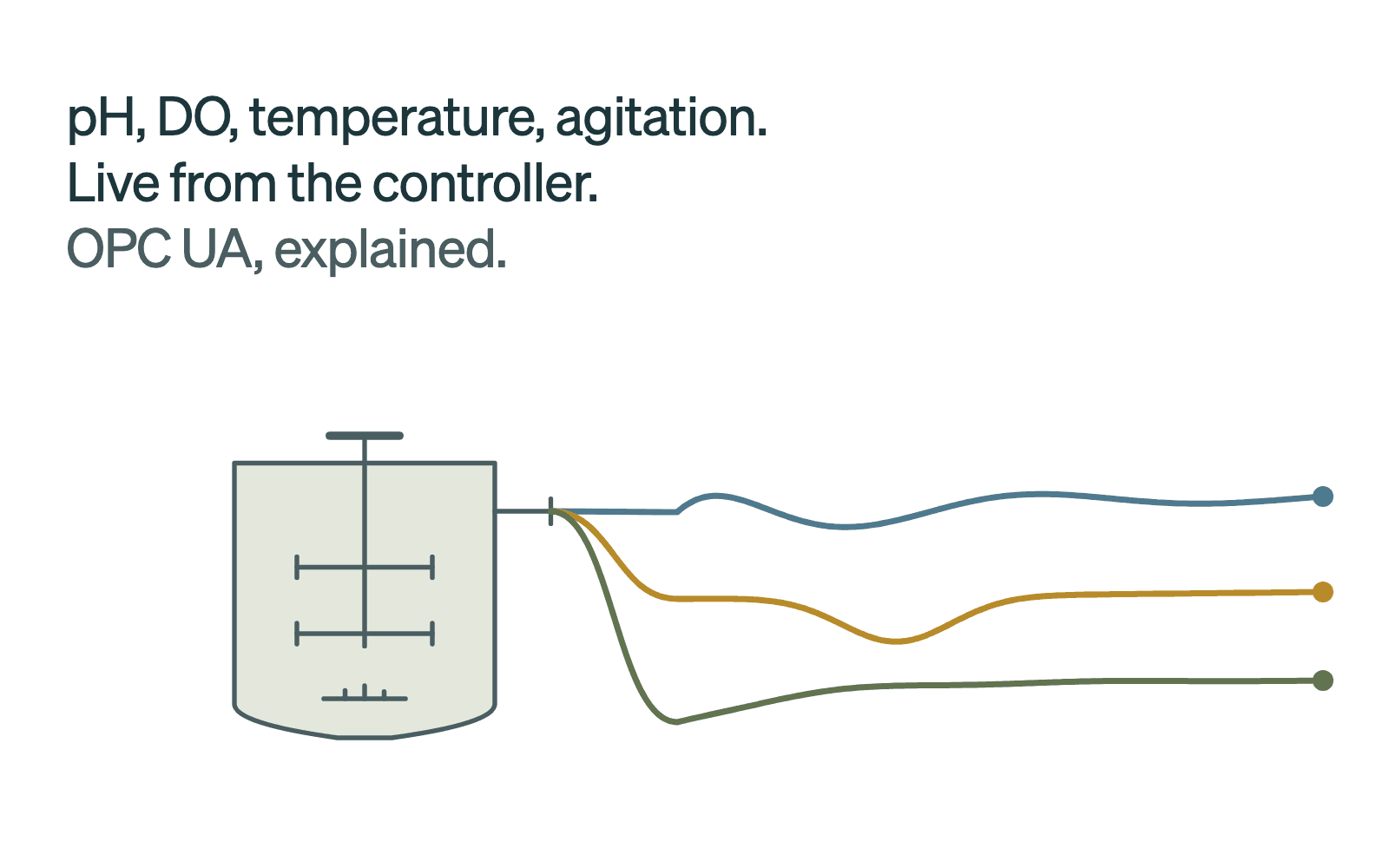
Invert connects bioreactor controllers, historians, and lab systems into one data layer organized around runs. Edge connectors, which your IT team installs on the site network, stream live data from AVEVA PI historians, from OPC UA sources such as Sartorius MFCS, DASGIP, and Ambr 250 systems, and from OPC DA sources such as the BioFlo 320. Invert links streamed data to the right run by time window. Benchling is the ELN connector, and LIMS data comes in through file import or API. See Invert's integrations and how bioreactors use OPC UA for more detail.
File and API imports use AI-assisted mapping, and each import is previewed and approved before it lands. Some instrument formats still need a custom parser.
Once the data is in one place, Invert Assist answers questions over it. It searches runs, loads data, runs Python, and builds charts. Each answer shows its code. Assist can extract values from scanned batch records and certificates of analysis for a person to check, and it changes data only through imports that a person reviews. Teams can save an analysis method as a Skill, run it on a schedule with Automations, and share results as Reports that keep the code next to the text and plots.
In a published case study, a clinical-stage cell therapy company connected five bioreactor systems across two sites. Batch analysis preparation went from days to near real time, and the company avoided up to $400K in third-party integration and custom development costs.
Invert does not execute batch records or control processes. It sits alongside manufacturing execution systems (MES) and control systems rather than replacing them.
2. Qubicon: Bioprocess Equipment Data in One Database
Qubicon, a Vienna-based software company, collects data from online, at-line, and offline bioprocess equipment into one central database. Equipment connects directly over OPC UA or through Qubicon's PAT-Box. Teams can compare live runs against reference runs, calculate KPIs and soft sensors from their own models in real time, and get an alert when a value leaves the reference range. The platform uses a client-server architecture.
Ask how LIMS, ELN, historian, and MES data would reach it.
3. Körber PAS-X Savvy: Contextualized Manufacturing Data and Analytics
PAS-X Savvy from Körber is a data management and analytics application for bioprocess development and manufacturing. It builds a contextualized data layer from manufacturing and quality sources and brings time-series and analytical data into one view, with dashboards, statistical trending, and support for continued process verification (CPV).
4. LabKey Server SDMS: Scientific Data Management System
LabKey Server SDMS is a scientific data management system that captures and harmonizes structured data from lab instruments, systems, and databases. It pairs with LabKey's Sample Manager, LIMS, and Biologics LIMS products, supports collaboration across teams and organizations, and manages access with group and role-based security. Check how bioreactor and historian data would come in.
5. Genedata Bioprocess: Lab Instrument Integration
Genedata Bioprocess is Genedata's platform for bioprocess data. Genedata is part of Danaher. The company says the platform can be integrated with any kind of laboratory instrument, including bioreactors. It covers upstream, downstream, and cell line development, with REST APIs for corporate IT systems. If historian or manufacturing sources are in scope, ask how the platform handles them.
6. TetraScience: Harmonized Lab Data Across Instrument Vendors
TetraScience converts lab data into a harmonized, open, vendor-agnostic format through its Scientific Data and AI Cloud. Its focus is laboratory data across many instrument vendors. If you need bioreactor data in run and batch context, ask how that context is added.
Related Systems: MES and Multivariate Analytics
Two other kinds of software often come up in the same evaluation. They sit next to the integration layer rather than in it.
Vimachem is a modular pharma MES with electronic batch records, OEE analytics, and live bioprocess monitoring. In a data integration project it is usually a source system to connect, not the integration layer.
Sartorius SIMCA, part of the Umetrics data analytics suite with MODDE, is multivariate analysis software for bioprocess data. SIMCA-online applies those models to live processes. It works on data once it is integrated, so teams often pair it with an integration layer.
Data Integration Features to Compare
Connecting Bioreactors and Historians (OPC UA, OPC DA, PI)
Ask which controllers, SCADA systems, and historians a platform connects to today, and over which interface. Newer equipment often exposes OPC UA, some installed systems still speak only OPC DA, and many sites keep a historian such as AVEVA PI. Check what has to be installed on site, who maintains it, and whether a new instrument type needs engineering work.
LIMS and ELN Integration
Offline results and experiment context usually live in a LIMS and an ELN. Ask whether a platform has a named connector for your LIMS and ELN or brings the data in by file import or API, and how often it syncs. A named connector, a scheduled file drop, and an API push can each work, but they need different upkeep.
Contextualizing Data by Batch and Run
Integrated data is only useful when each value is linked to the right run, batch, vessel, and phase. Ask how the platform assigns streamed data to a run, how it maps different tag names and units to shared variables, and how it handles a process that moves across systems or scales.
Process Data Management and Compliance
For GMP data, check audit trails, access controls, and electronic signatures against 21 CFR Part 11, and ask which of those apply to each product a vendor sells. The FAIR principles (findable, accessible, interoperable, reusable) are a useful test of whether the data will still be usable for the next program.
Frequently Asked Questions
What is the difference between a data integration platform and a LIMS?
A LIMS manages samples, tests, and results. A bioprocess data integration platform connects the LIMS with bioreactor controllers, historians, analytical instruments, and the ELN, and links the results to the run they came from. Most teams need both, so the practical question is how LIMS data reaches the integration layer.
What is a scientific data management system (SDMS)?
An SDMS captures, stores, and organizes data from lab instruments and systems so that it can be found and reused. LabKey Server SDMS is one example on this list. An SDMS is often built around lab records, while a bioprocess data integration platform is built around runs and batches.
How do these platforms address 21 CFR Part 11 requirements?
Part 11 sets FDA's expectations for electronic records and electronic signatures. Support varies by platform and by product, so ask each vendor which controls a given product provides, such as audit trails, access controls, and electronic signatures, and how it is validated.
Can these platforms share data with CDMO partners?
Coverage varies. Ask how data from a partner site arrives, how it is mapped to your naming and units, and who can see it.
What implementation timeline should we expect?
It depends on the number and type of sources, what has to be installed on site, and the validation scope. Connecting live instruments often needs IT to install software on the site network, and a new instrument type may need engineering work. A common approach is to start with one process or site and add sources in phases.
How significant are the cost savings?
Vendors publish their own figures, and they are hard to compare. Measure against your own baseline, such as the time from the end of a run to a usable dataset, or the hours spent on exports and spreadsheets before a batch review.
Conclusion & Next Steps
Start from your sources. List the systems that hold your process data, how each one exposes it (OPC UA, OPC DA, a historian, file export, or API), and how each value should link to a run or batch. Then compare platforms on the sources they connect today, the manual work that remains, and what your validation scope requires. A pilot on one process or site will answer most of these questions.
References
Invert: Bioreactor Platforms Case Study
Vimachem: Bioprocess Monitoring Software
European Pharmaceutical Review: FDA Warning Letters Highlight Data Integrity Issues (March 13, 2024)
FDA: Part 11, Electronic Records; Electronic Signatures, Scope and Application
Nature: The FAIR Guiding Principles for Scientific Data Management and Stewardship