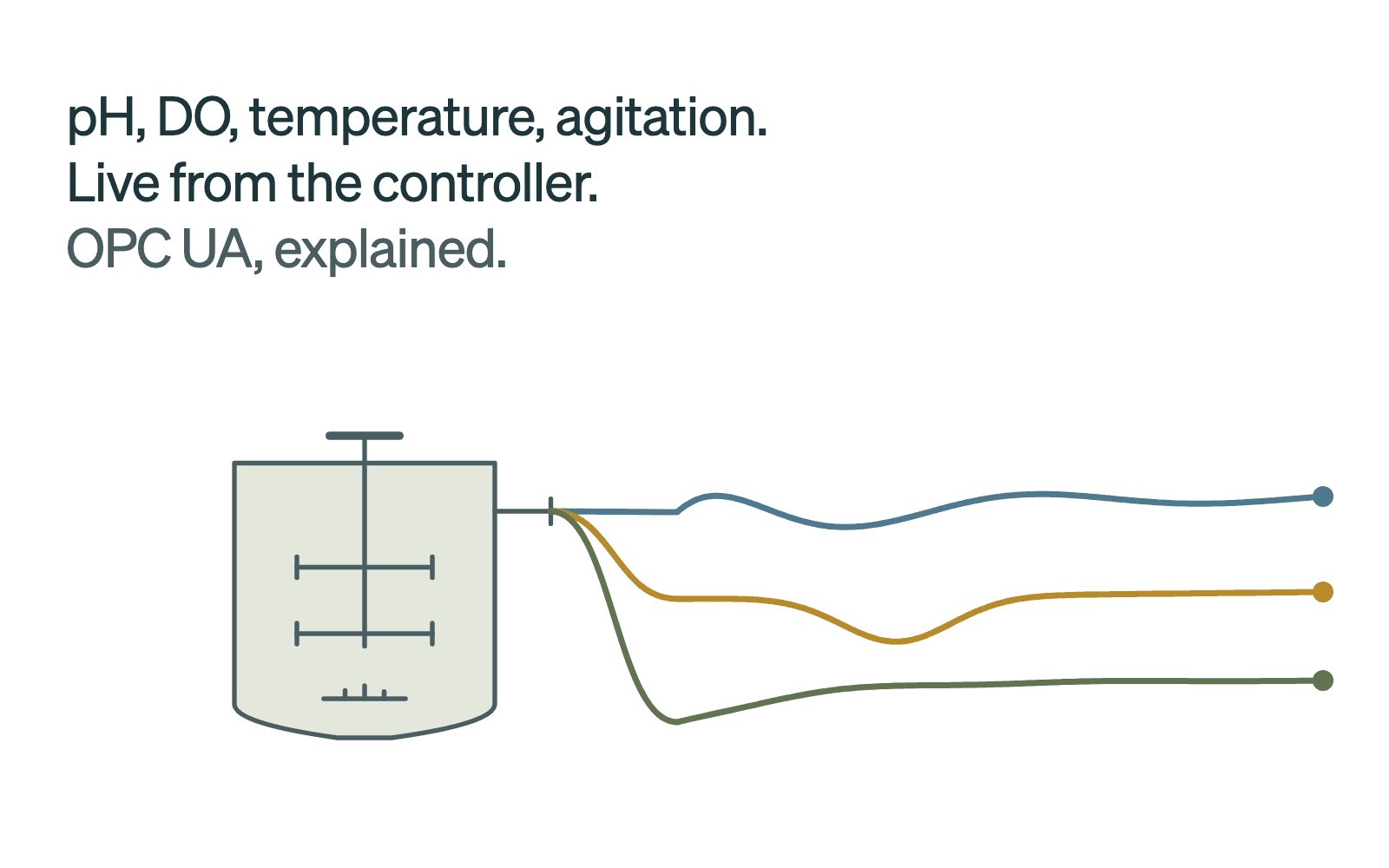
OPC UA is the open, vendor-neutral standard that industrial equipment uses to expose its live data to other software. The letters stand for Open Platform Communications Unified Architecture. In a bioprocess suite, it is how a bioreactor controller publishes pH, dissolved oxygen, temperature, agitation, gas flows, pump rates, and events while the run is in progress. Any authorized client can read them, with no vendor-specific driver and no file export.
This explainer covers what OPC UA is, how it differs from OPC DA, MQTT, and Modbus, and which bioprocess equipment speaks it. It also covers how Invert uses OPC UA, alongside the other interfaces your systems expose, to bring every signal into one place as the run happens.
What OPC UA is
OPC UA is maintained by the OPC Foundation and standardized as IEC 62541. Four properties matter for bioprocess data.
- Server and client. The equipment side runs an OPC UA server. Sometimes it sits in the vessel controller; more often it sits in the vendor's control software (Sartorius BioPAT MFCS, Eppendorf DASware) or a DCS such as DeltaV. Whatever reads the data runs a client, which browses the server, reads values, or subscribes to changes.
- An information model, not a register list. Each value is a node carrying engineering units, a source timestamp, and a status code, and nodes are grouped into objects. A vessel shows up as a vessel, with its sensors, setpoints, and alarms attached.
- Security in the specification. X.509 certificates identify server and client, messages can be signed and encrypted, and users authenticate. The server sets the policy and listens on port 4840 by default, which is why your automation or IT group is part of every OPC UA connection.
- Platform independence. It runs on Windows, Linux, and embedded controllers, and supports both client-server and publish-subscribe communication. Publish-subscribe runs over UDP or MQTT.
Laboratory equipment has a companion specification, OPC UA for Laboratory and Analytical Devices, or LADS. Published in 2023 as OPC 30500, it standardizes how instruments describe themselves. Its worked example of a device split into functional units is a bioreactor vessel with two containers, each with a temperature sensor, a motor, and a program. Most equipment in service predates LADS and exposes a generic OPC UA server, which is enough to stream process values.
OPC UA vs OPC DA
OPC DA (Data Access), often shortened to DA, is the original OPC specification from the 1990s, now called OPC Classic. It is built on Microsoft's COM and DCOM, so it runs only on Windows, and configuring DCOM across firewalls and domains is a well-known source of pain. It exposes a flat tag list of current values, and security is whatever Windows provides.
OPC UA replaces all of that in one platform-independent specification and is the right choice for anything new. The complication in bioprocess is the installed base. As of 2026, Cytiva's UNICORN software, which runs ÄKTA systems and Xcellerex XDR bioreactors, still speaks only DA, and it is not alone. UA and DA cannot talk to each other directly, so a client either speaks both or sits behind a gateway.
OPC UA vs MQTT vs Modbus
These three come up together, but they answer different questions.
| Protocol | What it defines | Units and metadata | Security | Where you meet it in bioprocess |
|---|---|---|---|---|
| Modbus (RTU, TCP) | How to read and write numeric registers on a device | None; you supply scaling, units, and meaning | None in the base protocol | Utilities, skids, PLC-to-PLC links |
| MQTT | A lightweight publish-subscribe transport through a broker | None on its own; Sparkplug B, an MQTT payload convention, adds one | TLS and broker credentials | Plant-to-cloud pipelines, IIoT platforms |
| OPC UA | Transport, security, and a typed information model in one specification | Built in: units, timestamps, status codes, object structure | Certificates, signing, encryption, user authentication | Bioreactor controllers, SCADA, DCS, historians |
In practice the three are layered rather than chosen between. Modbus gives you a number at an address. MQTT moves messages without saying what they mean. OPC UA defines the meaning and the security, and it can publish over MQTT.
Which bioprocess equipment speaks OPC UA
Most current bioreactor platforms do, sometimes at the controller and sometimes only through the vendor's SCADA. Invert is a bioprocess data platform that ingests data from equipment, historians, ELNs, and LIMS and runs monitoring, analysis, and reporting on top of it. The table lists the systems it connects to and the protocol each exposes. The full catalog, including ELN, LIMS, MES, and analytical instruments, is on the integrations page.
| Equipment | Vendor | Protocol | Where the server lives |
|---|---|---|---|
| Ambr 250 (HT / Modular) | Sartorius | OPC UA; periodic export | SCADA |
| Ambr 15 | Sartorius | Periodic export (no OPC) | SCADA |
| Biobrain (50 L class) | Sartorius | OPC UA | Controller |
| BioPAT MFCS 4 | Sartorius | OPC UA | SCADA |
| BIOSTAT B-DCU | Sartorius | OPC DA | Controller / SCADA |
| BioFlo, incl. BioFlo 320 | Eppendorf | OPC UA; OPC DA | SCADA |
| DASGIP, DASbox | Eppendorf | OPC UA | SCADA |
| BIOne 250 / 1250 | Distek | OPC UA; OPC DA | Controller |
| Xcellerex XDR / WAVE, ÄKTA | Cytiva | OPC DA | UNICORN software |
| Applikon bioreactors | Applikon | OPC UA; file watcher | Controller / SCADA |
| Infors bioreactors, Eve | Infors | API; OPC UA | SCADA |
| iCELLis | Pall | OPC UA; file upload | mPath Link software |
| TFF and filtration skids | Pall / Repligen | OPC UA | Controller |
| DeltaV | Emerson | OPC UA | DCS / historian |
| Ignition, Canary Historian | Inductive Automation, Canary | OPC UA; API or SQL | SCADA / historian |
When the server sits in the SCADA rather than in the vessel, you read what the SCADA has logged, at its sample rate. That is still live data.
OPC UA and the data historian
Bioprocess scientists rarely interact with OPC UA directly. Where a historian such as AVEVA PI, Canary, or DeltaV Continuous Historian sits between the equipment and the scientist, process data is typically collected continuously into the historian. It is then accessed downstream, often as an export after the run. Offline results arrive through a LIMS once the sample has been analyzed. In many labs there is no historian, so the path is a CSV pulled from the vendor software, a USB stick, or transcription.
A historian does its job well. It is the plant's long-retention record, it collects continuously, often over OPC itself, and its own trend tools show live values. The friction is not the historian. It is getting a complete, batch-labeled record of a run out of wherever the data landed and into the tool where the analysis happens. That is where the time goes, for the scientist who needs the data and for whoever gets asked to pull it.
- Batch context. Historian data is organized by tag, and a run is not a native object in it. Batch context can be added, for example with PI Event Frames or a batch historian. At many sites it is not configured, or it is only visible inside the vendor's own viewer. Someone then cuts the timeline into runs by hand, and ordinary mistakes creep in: one team's run zero-point was off by a day because pH logging began before inoculation. That cutting is the step that eats afternoons.
- Resolution. Storage settings decide what survives. Many historians compress or store by exception out of the box, and data handed over by a CDMO is often downsampled. An MSAT lead receiving bioreactor data from a CDMO put it this way: "I want to say it's like a five minute interval. So there's definitely some gaps, but I think that's just what their scan rate is." Whatever pH or DO did between those points is gone.
- Handling. Every export, transcription, or manual import is a place where units get dropped and timestamps shift. One fermentation group we spoke with assembles run comparisons by hand dozens of times a week. One upstream team spent two days on a single manual import.
Whichever path the data takes, the goal is the same: all of it, from every system, available while the run is still going, labeled by batch.
How Invert connects to bioprocess equipment
Invert connects to whatever interface a system already exposes. For bioreactor controllers and SCADA that is usually OPC UA or OPC DA. For a historian it is the PI Web API, SQL, or OPC UA. For analyzers and chromatography software it is the files they write, picked up by a file watcher. For ELN, LIMS, and MES it is their REST APIs. The connectors are pre-built for the common systems, so there is no protocol to choose and no middleware to build.
For live equipment data, your IT installs an edge connector on a machine that can reach the equipment network. That connector is the OPC UA client. It subscribes to the tags you select and streams them to Invert as the run proceeds. Where equipment speaks only OPC DA, or the data already sits in a PI historian, the same connector reads those interfaces instead. The stream does not know which batch it belongs to. Data assignment rules link it to the run by time window, so values land on the batch rather than in a tag pile. Alerts run on the live stream. Latency runs from about thirty seconds on Sartorius and Eppendorf controllers to about fifteen minutes on file-based paths such as UNICORN.
The connectors for Sartorius, Eppendorf, Distek, Cytiva, and the common historians are pre-built, so the connector work takes hours. The calendar time, typically about two weeks, is mostly IT: a host on the equipment network, outbound network access, and the OPC UA server trusting the client's certificate. On a locked-down manufacturing network that part can take longer. Two limits are worth knowing up front. The edge connector needs IT to install it and open access, and an instrument outside the connector catalog needs engineering work before it can stream.
One clinical-stage cell therapy company ran five bioreactor systems across two sites, from 2 L to 200 L, behind a historian that left scientists matching online data to batches by hand. It connected all five to Invert over OPC UA and OPC DA and kept batch definitions in its ELN; run monitoring now happens in Invert. Batch analysis prep went from days to near real time, and the company avoided up to $400K in integration and custom development costs. The case study has the details.
What this means for you
Every signal your equipment produces lands in one place, live, at the rate it was logged. Units and timestamps arrive intact, on the batch they belong to. Comparisons across runs, scales, and vendors start from tags mapped once to common metric names, which saves another round of reconciling metric names. Live view, alerts, and later trending in Invert run on the same data, alongside whatever your historian already does. OPC UA is one of the ways that data arrives. It is not something you have to operate.
Frequently asked questions
What does OPC UA stand for, and is it the same as OPC?
Open Platform Communications Unified Architecture. OPC is the family of specifications. The original set (Data Access, Historical Data Access, Alarms and Events) is now called OPC Classic, and OPC then stood for OLE for Process Control. OPC UA is the unified specification that replaced them, and the acronym was redefined along with it.
What is the difference between an OPC UA server and an OPC UA client?
The server owns the data, usually the controller or the vendor's control software. The client connects to browse, read, write, or subscribe. A bioreactor exposes a server; a data platform runs a client.
Does OPC UA replace a data historian?
No. OPC UA is a way to read equipment. A historian such as AVEVA PI, still OSIsoft PI to many people, is a place to store what was read, and it often collects over OPC UA itself. You can read at the equipment and keep the historian as the plant record. Invert connects to either.
Do I need OPC UA to use Invert?
No. OPC UA is one of several interfaces Invert reads. If your equipment exposes OPC DA, a PI historian, SQL, an API, or only files, the connector for that path is pre-built. OPC UA matters because most current bioreactor platforms expose it and it carries units, timestamps, and status with every value.
Does OPC UA expose everything the instrument records?
Usually most of it, not all. An automation lead at a large pharma who catalogued every parameter on their instruments' screens found that "OPC will cover [...] 70 or 80% of that generally. But the rest of the critical metadata is still just on the UI." What the server does not publish still arrives by file or by hand.
Do I need to buy an OPC license from the equipment vendor?
Often, yes. Many vendors sell the OPC server as a separate option, sometimes priced per tag, and some no longer offer it for older software versions. Confirm it per system before planning a live connection. A file-based path is the usual fallback until the license is in place.
Is OPC UA secure enough for a GMP network?
The specification includes certificate-based authentication, message signing, and encryption, more than OPC DA offered. The server sets which policy is enforced. Your automation or IT group normally owns that call, along with the network design around the edge host.
If you want to see live data from your own bioreactors in Invert, book a demo, or browse the integrations catalog.