TL;DR
Here are seven AI platforms for bioprocess optimization in 2026, and where each one starts: Invert, Aizon, Quartic.ai, Algocell, WisdomEngine, BioReact, and DataHow. Some start from the process data foundation, some from hybrid models, and some from plant operations. In December 2024, BCC Research estimated the bioprocess optimization and digital biomanufacturing market at $24.3 billion in 2024, growing to $39.6 billion by 2029, about 10.2% a year (BCC Research).
Updated September 2026. Invert publishes this list. Vendor details were checked against each company's own site, and all performance figures, including Invert's, are reported by the companies themselves.
| Platform | Starts from | Typical fit |
|---|---|---|
| Invert | A bioprocess data foundation with an AI analyst built in | Process development, MSAT, and manufacturing teams working across runs and sites |
| Aizon | GxP manufacturing data and predictive models | Commercial pharma, biotech, and CDMO manufacturing |
| Quartic.ai | Connecting legacy OT and IT systems, then analytics | Plants with established automation, in several industries |
| Algocell | Hybrid digital twins calibrated from a few runs | Teams with little historical data |
| WisdomEngine | First-principles engineering models combined with AI | Root-cause analysis and scale-up |
| BioReact | Bioreactor data alignment and media optimization | Upstream process development |
| DataHow | Hybrid models that combine mechanistic understanding with machine learning | Process development and scale-up |
1. Invert: Purpose-Built Bioprocess AI Software
Invert is bioprocess software with an AI analyst, Assist, built in. It brings data from bioreactors, historians, ELNs such as Benchling, and uploaded files into one place, linked to the run, so process development, MSAT, and manufacturing teams can analyze it without first assembling it by hand. It organizes data by run and batch.
Core capabilities:
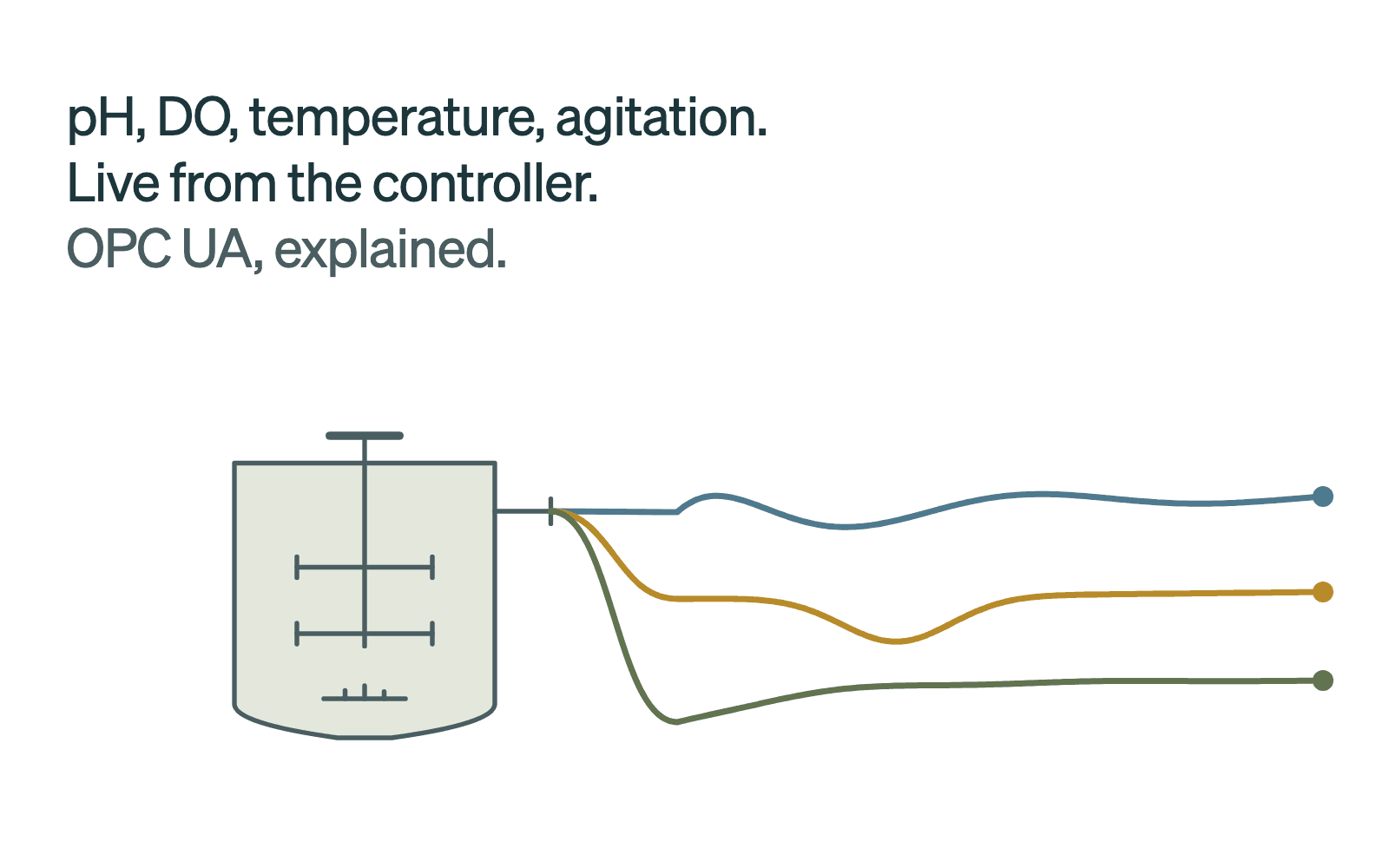
- Live connectors to equipment and historians. Pre-built connectors read OPC UA, OPC DA, and AVEVA PI, so bioreactor data streams in while the run is in progress.
- AI-assisted data onboarding. Assist proposes the mapping for new data sources, and every import is previewed and approved before it lands.
- Assist, an AI analyst for process data. It finds runs, loads their data, runs Python, builds charts, and applies your team's methods.
- Reports that keep the analysis. Text, charts, and the executable code sit in one shareable report, so a reviewer can see how each result was produced.
- Skills and Automations. A team writes its analysis method once as a Skill and runs it on a schedule.
- Review before any change. Assist corrects data only through reviewable imports, and it extracts values from scanned batch records for sign-off.
Impact:
One clinical-stage cell therapy company connected five bioreactor systems across two sites to Invert. Batch analysis prep went from days to near real time, and the company avoided up to $400K in integration and custom development costs (case study).
2. Aizon: GxP manufacturing intelligence
Aizon makes a GxP platform for pharma, biotech, and CDMO manufacturing. It includes Unify, a data layer over MES, LIMS, ERP, and historian data; Predict, for models that target yield and deviations; and Agentic Studio, which builds dashboards from natural-language requests. At one top-5 pharma company, Aizon reports a yield gain of more than 1.5% at a centrifugation step (Aizon).
3. Quartic.ai: manufacturing data and analytics
Quartic.ai builds manufacturing software in two layers: iLuminator connects legacy OT and IT systems, and eXponence runs multivariate analytics, machine learning, and agentic AI on that data. It serves several industries. Its life sciences work includes upstream processing, chromatography, and PAT. At a global pharmaceutical company that makes vaccines, Quartic reports a 10% yield improvement (Quartic.ai).
4. Algocell: hybrid digital twins
Algocell builds hybrid digital twins that combine mechanistic biological models with machine learning. Its platform, Algocell P, calibrates a model from a small set of runs and uses it to test operating protocols in silico, and the company reports up to 70% fewer trial-and-error experiments (Algocell). Its published case study covers a Pichia pastoris recombinant protein process.
5. WisdomEngine: bioprocess intelligence
WisdomEngine, a German process engineering and software company, offers Bioprocess Intelligence for analyzing batch data across lab, pilot, and production. The software combines first-principles engineering models with AI to support root-cause analysis, variability reduction, and scale-up decisions, and the company says it returns results within minutes (WisdomEngine). It runs in the cloud or on premises.
6. BioReact: bioreactor data and media optimization
BioReact is a bioprocess data platform that aligns online and offline bioreactor data, then provides visualization, statistics, and AI models for media and parameter optimization. The company says each optimization run can simulate up to 10,000 in-silico experiments, to reduce the number of physical runs (BioReact). The company was founded in 2023.
7. DataHow: hybrid models for bioprocess development
DataHow is a Zurich company, spun out of ETH Zurich in 2017. Its DataHowLab platform combines mechanistic process understanding with machine learning to help teams design fewer experiments, scale up, and monitor biopharma processes. DataHow reports that KBI Biopharma ran at least 40% fewer experiments than with a standard design of experiments (DataHow).
Market Overview & Growth Drivers
BCC Research estimates the global bioprocess optimization and digital biomanufacturing market at $22.4 billion in 2023 and $24.3 billion in 2024, and projects $39.6 billion by 2029, a compound annual growth rate of 10.2% (BCC Research). A separate estimate, with a different market definition, puts digital biomanufacturing at $27.25 billion in 2026 (Research and Markets). North America holds the largest share of the market (BCC Research), and Asia-Pacific is expected to grow fastest (Mordor Intelligence).
The drivers are familiar to anyone in the industry: demand for biologics, more complex modalities such as cell and gene therapies that need tighter manufacturing control, and regulatory expectations for process understanding under quality by design. For contract manufacturers and drug makers alike, the same batch data can serve development, tech transfer, and continued process verification.
Monoclonal antibodies, vaccines, and advanced therapy medicinal products are the main application areas. Each has its own optimization problems, from titer and product quality in antibody processes to small batch counts and patient-specific variability in cell therapy.
Core Technologies Powering the Shift
Process Analytical Technology (PAT) integration. Modern platforms bring PAT measurements into the analysis, in line with FDA guidance that encourages measuring quality attributes during processing rather than only after the batch (FDA).
Digital twin simulation. Bioprocess digital twins simulate a process so teams can test changes virtually before running them.
Hybrid machine learning models. Hybrid models combine mechanistic process understanding with machine learning, which lets them make useful predictions from fewer experiments than purely data-driven models need.
Real-time sensor data. Dissolved oxygen, pH, temperature, optical density, and spectroscopy data streamed during the run give the analysis a complete picture instead of end-of-run exports.
Real-World Impact and ROI
The returns come from fewer failed or repeated runs, faster development, and less time spent assembling data. Published examples are mostly vendor-reported. Quartic.ai, for example, reports a 75% reduction in design of experiments time for one customer (Quartic.ai), and Aizon reports a yield gain of more than 1.5% at one centrifugation step. Small percentage gains matter at commercial scale.
Frequently Asked Questions
Q: How quickly can we implement AI bioprocess optimization?
A: It depends on your data infrastructure. Most teams start with one process and one question, such as a recurring investigation or a comparison across runs, and expand once the data connections are in place.
Q: What data quality standards are required for AI platform success?
A: Clear ownership, consistent units and naming, and data linked to the run or batch it came from. A platform that previews and checks data as it is imported reduces the cleanup, but it helps to agree on what "good data" means before you start.
Q: How do these platforms support regulatory compliance?
A: Look for audit trails, user access controls, and documentation of how each result was produced. For GxP use, confirm which parts of a platform are validated for your use case and how it supports 21 CFR Part 11.
Q: Can AI platforms work with existing bioreactor systems?
A: Yes. Most connect to existing equipment and historians through standard interfaces such as OPC UA, OPC DA, or historian APIs, so new capital equipment is usually not needed. Plan for your IT team's involvement, because connections to the equipment network need their approval.
Q: What skills are required to operate these platforms?
A: Platforms are increasingly usable by scientists who are not data scientists. Teams still benefit from bioprocess engineering expertise, basic data interpretation skills, and quality system knowledge.
Conclusion & Next Steps
Most published results for AI in bioprocess optimization are still vendor-reported, from one site or one process step. Ask each vendor for a reference on your modality and scale.
The right platform depends on where your team starts. If your data is still spread across instruments, historians, and spreadsheets, start with a platform that brings it together and makes it analyzable. If your data is already consolidated, a modeling-first tool may be the faster path.
Evaluate the leading platforms through pilots focused on a specific problem, agree on data ownership early, and build internal skills alongside the tools.
The Bottom Line
Invert is bioprocessing software built specifically for bioprocess data. It pairs that data foundation with an AI analyst that shows its work.
For teams whose process data sits in many systems, Invert brings it into one place and keeps the data, the analysis, and the code together in one shareable report.
References
BCC Research: Bioprocess Optimization and Digital Bio-Manufacturing, Global Markets
GlobeNewswire: Bioprocess Optimization and Digital Bio-manufacturing Market Forecast 2029
Research and Markets: Digital Biomanufacturing Market Report
Mordor Intelligence: Digital Biomanufacturing Market
FDA: Process Analytical Technology Guidance
WisdomEngine: Bioprocess Intelligence
Körber Pharma: What is a Bioprocess Digital Twin
Frontiers in Bioengineering and Biotechnology: AI in Bioprocessing
PubMed Central: Hybrid Models in Bioprocesses
Bioprocessing Summit: Digital Transformation
Pharm Outsourcing: Bioprocessing 4.0 and Smart Manufacturing
BioProcess International: Data Overabundance in Biomanufacturing